Basic French Phrases for Travelers: A Paris Survival Cheat Sheet


Will you survive a trip to Paris speaking only English? Almost certainly yes. In hotels, museums, big restaurants and any tourist area, someone will speak enough English to help you. But here is the secret most guidebooks bury: Parisians are far warmer to visitors who make even a tiny effort in French, and the effort that matters most is not a full sentence — it is a single word, Bonjour, said at the right moment. This survival-French cheat sheet gives you the handful of basic French phrases for travelers that genuinely change how you are treated, grouped by situation, with simple pronunciation you can read out loud.
You do not need to be fluent. You need about twenty phrases and one golden rule. Learn the greetings, keep this page open on your phone, and you will move through Paris more smoothly — and more warmly — than most visitors ever do.
Do They Speak English in Paris?
Yes — far more than the city's frosty reputation suggests. In the tourist heart of Paris, around the Eiffel Tower, the Louvre, the Champs-Élysées, major hotels, department stores and popular restaurants, staff routinely speak functional English, and younger Parisians often speak it well. Menus in tourist districts frequently have English versions, and museum signage is bilingual. If you never learned a word of French, you would still get by.
So why bother? Because getting by and being welcomed are two very different experiences. The traveler who opens with a polite French greeting before switching to English is treated as a courteous guest; the one who marches up and starts in English is more likely to meet the famous Parisian coolness. The language barrier in Paris is rarely about vocabulary — it is about etiquette. Master the etiquette, and the English takes care of the rest.
Why Is “Bonjour” the Most Important Word in Paris?
If you remember only one thing from this guide, remember this: always say Bonjour first. In French culture, walking into a shop, café, bakery or taxi and launching straight into a request — even a polite one in English — can read as abrupt, almost rude. The expected ritual is to greet the person first: a warm Bonjour (or Bonsoir in the evening), and then your question. That single word signals “I see you as a person, not a vending machine,” and it transforms the response you get.
The full etiquette is just as simple. Think of it as the Bonjour–Merci–Au revoir rule:
- Bonjour when you arrive or begin any interaction.
- S'il vous plaît (please) attached to every request.
- Merci (thank you) when you receive anything.
- Au revoir (goodbye) when you leave — yes, even a shop where you bought nothing.
Follow that four-word arc and you will already come across as more polite than the average visitor. Everything else in this guide is a bonus.
How Do You Pronounce French Without Studying It?
French spelling looks intimidating, but a few shortcuts get you surprisingly close:
- Silent endings: final consonants are usually not pronounced — Paris sounds like “pa-REE”, beaucoup like “boh-KOO”.
- Nasal sounds: the groups on, an and in are hummed through the nose rather than fully spoken — approximate them and you will be understood.
- The French R: a soft sound made at the back of the throat; if you cannot manage it, a light English r is perfectly clear.
- Even stress: French words are said flatly, with a gentle rise at the end, rather than hitting one strong syllable.
In the lists below, the capital letters show where to push very lightly. Do not aim for perfection — aim for a friendly attempt. Parisians hear the effort, not the accent.
Greetings and Politeness: The Phrases That Open Doors
These are the non-negotiables. If you learn nothing else, learn these. The format is French — (pronunciation) — meaning.
- Bonjour — (bon-ZHOOR) — Hello / Good day
- Bonsoir — (bon-SWAHR) — Good evening
- Au revoir — (oh ruh-VWAHR) — Goodbye
- S'il vous plaît — (seel voo PLEH) — Please
- Merci (beaucoup) — (mair-SEE boh-KOO) — Thank you (very much)
- De rien — (duh ree-AN) — You're welcome
- Excusez-moi — (ex-koo-zay MWAH) — Excuse me (to get attention)
- Pardon — (par-DON) — Sorry / pardon (to squeeze past)
- Oui / Non — (WEE / NON) — Yes / No
- Parlez-vous anglais? — (par-lay-VOO on-GLEH) — Do you speak English?
- Je ne comprends pas — (zhuh nuh kom-PRON pah) — I don't understand
What Do You Say at a Café or Restaurant?
Ordering is where a little French pays off fastest — and where the Bonjour rule matters most, because you are entering someone's space. Note the local secret: ask for une carafe d'eau and you get free tap water instead of a pricey bottle.
- Une table pour deux, s'il vous plaît — (oon TAH-bluh poor DUH) — A table for two, please
- La carte, s'il vous plaît — (lah KART) — The menu, please
- Je voudrais... — (zhuh voo-DREH) — I would like... (the polite way to order)
- Une carafe d'eau — (oon ka-RAHF doh) — A jug of tap water (free)
- Un café / un thé — (uhn ka-FAY / uhn TAY) — A coffee / a tea
- L'addition, s'il vous plaît — (lah-dee-see-ON) — The bill, please
- Sur place / à emporter — (soor PLASS / ah om-por-TAY) — Eat in / take away
- C'était délicieux — (say-TEH day-lee-see-UH) — It was delicious
Which French Phrases Help When Shopping?
From bakeries to boutiques, these keep transactions smooth. Remember to greet first and say au revoir on the way out, even if you buy nothing.
- Combien ça coûte? — (kom-bee-AN sah KOOT) — How much is it?
- Je regarde, merci — (zhuh ruh-GARD mair-SEE) — I'm just looking, thanks
- Je voudrais ceci — (zhuh voo-DREH suh-SEE) — I would like this one
- Est-ce que je peux payer par carte? — (es-kuh zhuh puh pay-YAY par KART) — Can I pay by card?
- C'est trop cher — (say troh SHAIR) — It's too expensive
- Avez-vous...? — (a-vay-VOO) — Do you have...?
How Do You Ask for Directions and Use the Metro?
Paris is walkable and its metro is dense; these phrases get you unstuck. If you look lost near a station, a quick Bonjour, excusez-moi works wonders.
- Où est...? — (oo EH) — Where is...?
- Où sont les toilettes? — (oo son lay twah-LET) — Where are the toilets?
- À gauche / à droite / tout droit — (ah GOSH / ah DRWAHT / too DRWAH) — Left / right / straight ahead
- Un ticket, s'il vous plaît — (uhn tee-KAY) — A metro ticket, please
- C'est loin? — (say LWAN) — Is it far?
- Je voudrais aller à... — (zhuh voo-DREH a-LAY ah) — I would like to go to...
What Are the Essential Emergency Phrases?
You will almost certainly never need these — but knowing them is the cheapest insurance you can carry. Save one number in your phone: 112, the free European emergency line, which has English-speaking operators.
- Au secours! — (oh suh-KOOR) — Help!
- Appelez la police — (a-play lah po-LEES) — Call the police
- Appelez une ambulance — (a-play oon om-boo-LONSS) — Call an ambulance
- J'ai besoin d'un médecin — (zhay buh-ZWAN duhn mayd-SAN) — I need a doctor
- Je suis perdu(e) — (zhuh swee pair-DOO) — I am lost
- Où est l'hôpital? — (oo eh loh-pee-TAL) — Where is the hospital?
How Do You Count in French? (Numbers 1 to 10)
Handy for prices, addresses, metro lines and how many croissants you want.
- 1 un (uhn) · 2 deux (DUH) · 3 trois (TRWAH) · 4 quatre (KAT-ruh) · 5 cinq (SANK)
- 6 six (SEESS) · 7 sept (SET) · 8 huit (WEET) · 9 neuf (NUHF) · 10 dix (DEESS)
- Useful bigger ones: 20 vingt (VAN) · 50 cinquante (san-KONT) · 100 cent (SON)
Which Little Phrases Make Parisians Warm Up?
Beyond the essentials, a few extra words turn a polite exchange into a genuinely warm one. Drop these in and watch faces soften:
- Je suis désolé(e) — (zhuh swee day-zo-LAY) — I'm sorry
- C'est parfait, merci — (say par-FEH mair-SEE) — That's perfect, thank you
- Bonne journée! — (bon zhoor-NAY) — Have a good day! (a lovely way to leave)
- Vous êtes très aimable — (voo-zet trez em-AH-bluh) — You are very kind
- Santé! — (son-TAY) — Cheers! (when raising a glass)
None of these are strictly necessary, and that is exactly why they land: using them shows you cared enough to go one step past survival. That small generosity is almost always returned in kind.
How Do You Turn Bonjour Into a Real Paris Memory?
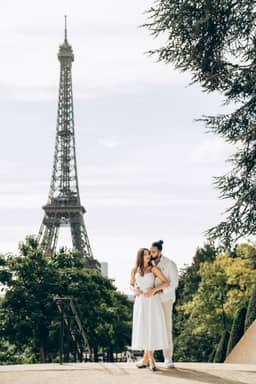
Here is the lovely irony: the moment you stop worrying about the language, you start noticing how photogenic Paris is — and how much you want to remember this trip properly. A relaxed local photographer removes that last barrier entirely. You simply show up and enjoy the city while someone captures you in front of the Eiffel Tower, along the Seine or on a café terrace. A captivating Paris photo tour at the Eiffel Tower is booked online in minutes with the price shown upfront, and needs exactly zero French from you. Browse the full catalog of Paris photo experiences and pair your new phrases with photos worth keeping.
Learn the greetings, say Bonjour first, and Paris opens up. Bon voyage — and bonne chance!
FAQ
Do they speak English in Paris?+
Yes, especially in tourist areas. Around the Eiffel Tower, the Louvre, big hotels, department stores and popular restaurants, staff usually speak functional English, and many younger Parisians speak it well. You can travel through Paris on English alone. But opening with a French Bonjour before switching to English changes the welcome you get: it marks you as courteous, and Parisians reward the effort warmly.
What are the most important French phrases for a tourist?+
If you learn only five, make them Bonjour (hello), S'il vous plaît (please), Merci (thank you), Excusez-moi (excuse me) and Au revoir (goodbye). Add Parlez-vous anglais? (do you speak English?) and you can start almost any interaction politely. These six words carry you through shops, cafés and the metro, and they signal respect far more than perfect grammar ever would.
Why do Parisians expect you to say Bonjour first?+
In French culture, greeting someone before making a request is basic courtesy, not an optional nicety. Walking into a shop or café and starting straight in — even politely, even in English — can feel abrupt. A warm Bonjour (or Bonsoir after dark) first acknowledges the person, and only then comes your question. Skip it and you may meet the famous Parisian coolness; use it and doors open.
Do I need to speak French to visit Paris?+
No. Paris is one of the world's most visited cities and its tourist infrastructure runs comfortably in English — signage, menus and staff in central areas all cope with English speakers. What you need is not fluency but etiquette: a handful of polite French words used at the right moments. Keep a phrase list on your phone, lead with Bonjour, and you will be perfectly fine.
How do you order food in French at a Paris café?+
Greet first with Bonjour, then order politely using Je voudrais (I would like) followed by what you want and s'il vous plaît. Ask for une carafe d'eau to get free tap water instead of a paid bottle, and l'addition, s'il vous plaît for the bill, which will not arrive until you request it. A merci, au revoir on the way out completes the ritual.
What is the emergency number in Paris?+
Dial 112, the free European emergency number, which works from any phone across the EU and has English-speaking operators — the simplest option for travelers. You can also use 15 for medical emergencies (SAMU), 17 for police and 18 for the fire brigade. Useful phrases include Au secours! (help!) and J'ai besoin d'un médecin (I need a doctor).