Eiffel Tower Photoshoot: The Complete Playbook for All 7 Best Spots

The spots on the map
All 45 real photo locations — tap a pin to see the spot and book it.
An Eiffel Tower photoshoot is the most requested photo session in Paris — and the easiest one to get wrong. Show up at noon on a Saturday and you will share the frame with thousands of visitors; arrive at sunrise at the right vantage point and you get the tower, the light and the whole esplanade almost to yourself. This playbook compares all seven classic shooting locations, explains when the light is best in every season, and shows what a professional session really costs — real packages start at €150, bookable online in minutes.
Everything below reflects what working photographers actually do on the ground every week: where they stand, when they start, how they dodge the crowds, and what they tell their clients to wear.
The 7 best Eiffel Tower photoshoot spots, compared
The tower is visible from half of Paris, but seven vantage points produce the images people fall in love with. They all sit within a 20–25 minute walk of each other, so a single session can combine two or three.
1. Trocadéro esplanade — the classic postcard
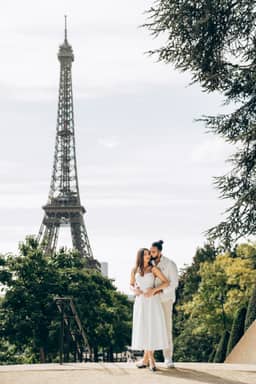
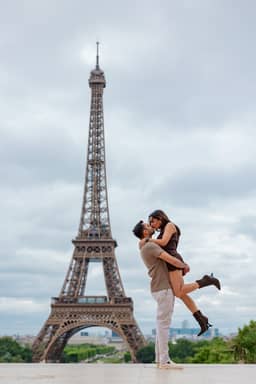
The elevated terrace between the wings of the Palais de Chaillot looks straight across the Seine at the tower: full height, perfect symmetry, nothing in the way. It is the most famous view in Paris and the anchor of almost every Trocadéro photoshoot. The price of fame is company — from mid-morning the esplanade is packed. Come at sunrise and the difference is night and day (métro Trocadéro, lines 6 and 9).
2. Trocadéro gardens and the carousel
Walk down the steps toward the Seine and the mood changes completely: sloping lawns, stone balustrades, fountains, and the old-fashioned carousel near Pont d'Iéna with the tower rising behind it. The lower angle adds foreground and depth, and the gardens absorb crowds far better than the terrace above. The carousel frame — lights on, tower behind — is a favourite for couples and families.
3. Pont de Bir-Hakeim — upper and lower decks
This double-decker bridge is two locations in one. The lower deck gives you the river, ornate lampposts and a clean side view of the tower, while the central walkway beneath the metro viaduct is a corridor of steel columns with hypnotic leading lines — moody, cinematic, and familiar from more than one famous film. It shines in soft morning light and at blue hour, and it is one of the rare spots that still works in the rain (métro Bir-Hakeim or Passy, line 6).
4. Avenue de Camoëns — the Haussmann staircase
A tiny dead-end street on the Trocadéro hill with an elegant stone staircase and balustrade, the tower framed between classic Haussmann façades. It feels like a private Parisian balcony, flatters elegant outfits and close portraits, and stays quiet long after the esplanade fills up. Arrive early anyway: the spot is small, and a handful of photographers can occupy it.
5. Rue de l'Université — the hidden street view
On the 7th-arrondissement side, the western end of Rue de l'Université suddenly opens onto the tower filling the whole gap between the buildings. This is the “quiet Paris street with a giant tower” image: cream façades, wrought-iron balconies, a café corner nearby. Because it is a normal residential street it stays workable at hours when Trocadéro is impossible — just keep the sidewalk clear and the sessions short.
6. Champ-de-Mars — lawns, picnics and proposals
The long green axis at the tower's feet is the relaxed option: blankets, picnic setups, children running, and the tower vertical and enormous behind you. The tree-lined side alleys give leafy frames in summer and golden tunnels in autumn. It is the natural choice for family sessions and proposals, and the closest of the seven to the tower itself.
7. Port Debilly — the Seine-level quay
Down on the right-bank quay between Pont d'Iéna and the Passerelle Debilly you shoot at water level: cobblestones, moored boats, reflections, and an unobstructed diagonal view of the tower. Visitors rarely think of it, so it is a reliable escape when everything above is crowded — and at dusk the tower's lights double themselves in the Seine.
Two ready-made itineraries
Not sure how to combine the spots? These two routes cover the classics without wasted walking:
- The 60-minute sunrise classic: start on the Trocadéro esplanade for the symmetrical postcard, drop down through the gardens for the carousel and fountain frames, and finish on the Avenue de Camoëns staircase while the light is still soft. Three looks, zero transport.
- The 90-minute golden-hour loop: begin on the lower deck of Bir-Hakeim for the cinematic columns, walk the river down to Port Debilly for Seine reflections as the sun drops, then climb to the esplanade at dusk and stay for the first sparkle.
Both routes work in reverse, and a photographer who shoots the tower every week will adjust them on the spot to the light, the wind and the crowd of the day.
Sunrise, sunset or sparkle hour?
Sunrise — empty Paris, pastel light
For a classic Trocadéro session there is no debate: sunrise wins. You get soft pastel light behind the tower, gentle tones on the stone and — crucially — space. Before about 8:00, even in high season, you can shoot the esplanade, the gardens and Camoëns with almost nobody in the background. Plan to start 20–30 minutes before the official sunrise time: the pre-dawn glow is often the best light of the entire day.
Golden hour and sunset — warm light, more people
In the evening the sun sets behind Trocadéro, so the tower's face catches warm, honey-coloured light — gorgeous, but shared with the biggest crowds of the day. Evening sessions work best at the quieter spots: Port Debilly, Bir-Hakeim, Rue de l'Université. A good compromise for non-morning people: start ninety minutes before sunset away from Trocadéro and finish on the esplanade as the crowd thins at dusk.
Sparkle hour — five minutes at the top of every hour
After nightfall the tower's golden lighting comes on, and for five minutes at the top of every hour about 20,000 flashbulbs make it sparkle — currently until a final show around 23:00. On camera it is pure magic, especially from Trocadéro or across the water at Port Debilly. One nuance worth knowing: the daytime tower can be photographed and published freely, but the night-time light show is protected as an artistic work — personal photos and your own social media are fine, while commercial use of night images technically requires authorisation. Your photographer will know how to handle it.
Pro tip: book the sunrise slot, then keep the evening free. If the morning turns out grey you still have golden hour and sparkle hour the same day as a natural plan B.
When the light happens: season by season
Paris sits quite far north, so shooting times swing enormously through the year. Approximate times to plan around:
- June–July: sunrise around 5:50, sunset around 21:55. An early alarm, but the city is empty; the first sparkles come only near 23:00.
- March–April and September–October: sunrise 7:00–7:45, sunset 19:30–20:30. The comfortable compromise — golden light at civilised hours.
- December–January: sunrise around 8:40, sunset around 17:00. The only season when you can shoot sunrise, blue hour and the sparkles all before dinner.
- Any month: the tower lights up at dusk and sparkles on the hour — in winter you can catch the show from about 18:00, in midsummer not before 23:00.
Avoiding the crowds (and the souvenir sellers)
Crowd management at the Eiffel Tower is 80% timing and 20% positioning:
- Go at sunrise. Weekday mornings are the quietest of all; weekend middays and public holidays are the busiest.
- Work the axis. On the esplanade, shooting from slightly off-centre keeps other visitors out of frame while preserving the symmetry.
- Have a spot ladder. If the esplanade is full, drop to the gardens, then Camoëns, then Bir-Hakeim — crowd density falls with every step.
- Souvenir sellers cluster around Trocadéro and Pont d'Iéna. A polite “non merci” is all it takes; keep phones and bags zipped in dense moments, as anywhere touristy.
The rain plan
Paris drizzle is frequent and rarely ruins a session — some of the most atmospheric Eiffel Tower photos are taken on wet days:
- The covered central walkway of Bir-Hakeim lets you keep shooting through real rain.
- Wet stone at Trocadéro turns into a natural mirror, with tower reflections at your feet.
- A transparent umbrella costs a few euros and reads as a styling choice, not an accessory of defeat.
- If the forecast is hopeless, most sessions can be rescheduled to another slot — check the conditions shown on the service page when you book.
What to wear
The tower is dark iron against a usually pale sky, so outfits that work share one idea: contrast and movement.
- Strong solid colours — red, emerald, royal blue, black or cream — pop against both the lattice and the stone.
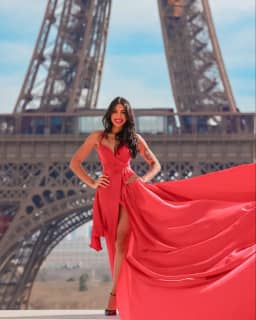
- Long dresses that move photograph beautifully on the esplanade and the Camoëns stairs; a gust of wind becomes a feature, not a problem.
- Skip busy prints and big logos — they fight the architecture.
- Shoes: cobbles and stairs everywhere. Walk in flats, switch to heels only while posing.
- For maximum drama, a flying dress session — a billowing train lifted on cue — was designed for exactly this backdrop.
Real packages, real prices
These are live, instantly bookable Eiffel Tower sessions with fixed prices — no quote requests, no haggling:
- Eiffel Tower photo shoot — the classic private session at the vantage points above, from €150.
- Captivating Paris Photo Tour: Eiffel Tower — a guided shoot-as-you-walk itinerary covering the tower's best angles, from €150.
- Capture Your Elegance: Flying Dress Photoshoot in Paris — dress, styling and choreographed flying shots at the tower, from €360.
- Capture Timeless Moments at The Eiffel Tower & Louvre Photoshoot — one morning, two icons, from €350.
Each listing shows exactly what is included — duration, number of retouched photos, delivery time and the precise meeting point — before you pay.
Book your Eiffel Tower photographer in minutes
Kapturia is an instant-booking marketplace: choose a session, pick a date and a time slot, pay online, and your Eiffel Tower photographer is confirmed — no email ping-pong, no quote forms. Browse all Paris photoshoot services, compare packages and verified reviews, and lock in your sunrise slot before someone else does.
Two practical notes: sunrise slots are the first to go — in high season the best photographers' morning calendars fill up one to two weeks ahead, so book as soon as your travel dates are fixed. And if you are planning a proposal, mention it in the booking notes: your photographer will arrive early, scout a discreet angle and keep the secret until the knee touches the ground.
One tower, seven vantage points, one golden rule: come early, and let a professional handle the rest.
FAQ
How much does an Eiffel Tower photoshoot cost?+
On Kapturia, a private Eiffel Tower photo shoot starts at €150, and the guided photo tour around the tower's best angles also starts at €150. Signature experiences cost more: the flying-dress photoshoot starts at €360 and the Eiffel Tower and Louvre combo session at €350. Every price is fixed and shown upfront with the duration, the number of edited photos and the delivery time — you book and pay online in a couple of minutes.
What is the best time of day for an Eiffel Tower photoshoot?+
Sunrise, by a wide margin. Before about 8:00 the Trocadéro esplanade, the gardens and the Avenue de Camoëns stairs are close to empty, and the light behind the tower is soft and pastel. Sunset gives warmer light on the tower's face but brings the day's biggest crowds, so evening sessions work better at Port Debilly, Bir-Hakeim or Rue de l'Université. After dark, the sparkle show adds five magical minutes at the top of every hour.
Can I use photos of the illuminated Eiffel Tower at night?+
For personal use, yes — print them, share them, post them on your social accounts. The legal nuance concerns commercial publication: the tower itself is in the public domain, but the night-time lighting and sparkle show is protected as an artistic work, so commercial use of night images technically requires prior authorisation from the tower's operating company. Daytime photos carry no such restriction, which is one more argument for a sunrise session.
Which Eiffel Tower viewpoint is best for my session?+
For the classic full-height postcard, the Trocadéro esplanade is unbeatable, with the gardens and the carousel just below for depth and foreground. Couples who want something more cinematic love the columns of Bir-Hakeim and the Haussmann staircase on Avenue de Camoëns. Rue de l'Université gives the hidden-street look, Champ-de-Mars suits relaxed family sessions, and Port Debilly adds Seine reflections. Most one-hour sessions comfortably combine two or three neighbouring spots.
What happens if it rains on the day of my shoot?+
Light drizzle rarely stops a session — wet stone at Trocadéro turns into a mirror, a transparent umbrella becomes a prop, and the covered walkway of Pont de Bir-Hakeim lets you keep shooting through heavier rain. If the forecast is truly hopeless, most sessions on Kapturia can be moved to another slot: check the rescheduling conditions shown on the service page when you book.