Golden Hour in Paris: The Best Time for Photos, Month by Month

Photographers have a saying: in Paris you are not really photographing buildings, you are photographing light. The city's pale limestone was practically designed to catch the sun, and there is one window each morning and evening when it stops being grey stone and turns to warm honey. That window is golden hour, and learning to plan around it is the single biggest upgrade you can give your Paris photos, whether they are taken on a phone or by a professional. This guide explains what golden hour and blue hour actually are, how the best time for photos in Paris shifts dramatically from June to December, which famous spots face which way, and how to build a whole session around the light.
Paris sits surprisingly far north — further north than Montréal or Seattle — so its daylight swings hard with the seasons. A summer evening here stays golden until nearly ten o'clock; a December afternoon is soft and low all day and finished by five. Once you understand that rhythm, you can choose your hour, your direction and your backdrop with confidence, and stop leaving the most flattering light of the day to chance.
What Golden Hour and Blue Hour Actually Are
Golden hour is the roughly sixty minutes just after sunrise and just before sunset, when the sun sits low — under about six degrees above the horizon — and its light travels sideways through a thick slice of atmosphere. That long path filters out the harsh blue end of the spectrum and leaves warm gold and amber. Shadows grow long and soft, contrast drops, and skin tones glow instead of squinting under a hard overhead sun. It is not a marketing word; it is simple physics, and it is free.
Blue hour is its quieter cousin: the twenty to thirty minutes after the sun has dropped below the horizon, or before it rises. The sky turns a deep, saturated cobalt while there is still enough light to hold detail, and crucially the city's own lights switch on. In Paris that overlap — natural blue sky plus warm street lamps and monument floodlights — is pure magic, and it is why so many iconic Eiffel Tower photos are shot in that narrow band rather than in full daylight or full dark.
The exact length of both windows changes with the season. Near the summer solstice the sun sets at a shallow angle and golden hour can stretch well beyond sixty minutes; in midwinter the sun cuts down more steeply and the magic is briefer, but it also arrives at a far more comfortable time of day.
Paris Light, Month by Month
Here is an approximate month-by-month guide to sunrise and sunset in Paris. Treat every time as a rough marker, not a timetable: the sun moves a little every single day, and the figures below are mid-month estimates. Note too that France changes its clocks — forward on the last Sunday of March, back on the last Sunday of October — which is why the jump between March and April, and between October and November, looks so abrupt.
- January — sunrise around 8:35 am, sunset around 5:15 pm. Short days, but a beautifully low, soft light for the few hours it lasts.
- February — sunrise around 8:00 am, sunset around 6:05 pm. Days lengthening quickly; crisp, clear light after cold fronts.
- March — sunrise around 7:10 am, sunset around 6:50 pm (clocks spring forward late in the month).
- April — sunrise around 7:00 am, sunset around 8:45 pm. Blossom season, and long, gentle evenings return.
- May — sunrise around 6:10 am, sunset around 9:25 pm. One of the very best months: warm, long golden hours.
- June — sunrise around 5:50 am, sunset around 9:55 pm. The longest days of the year; golden hour can run past 9 pm.
- July — sunrise around 6:10 am, sunset around 9:45 pm. Long, hazy-warm evenings, though the city is busy.
- August — sunrise around 6:50 am, sunset around 9:00 pm. Evenings drawing in slightly; softer, honeyed light.
- September — sunrise around 7:35 am, sunset around 8:00 pm. A favourite of photographers: warm light, thinner crowds.
- October — sunrise around 8:15 am, sunset around 7:00 pm (clocks fall back late in the month, then sunset drops to about 5:30 pm).
- November — sunrise around 7:45 am, sunset around 5:15 pm. Moody and atmospheric, often the most dramatic skies of the year.
- December — sunrise around 8:40 am, sunset around 4:55 pm. The shortest days, but a lie-in and a late-afternoon golden hour make winter shoots wonderfully civilised.
The practical takeaway: in high summer you must either wake very early or shoot late into the evening to catch golden light, while in winter the same magic is available mid-morning or mid-afternoon, no alarm clock required.
How Haussmann Stone Turns Honey-Gold
There is a specific reason Paris photographs so warmly at golden hour, and it is literally built into the city. When Baron Haussmann rebuilt Paris in the nineteenth century, his uniform boulevards were faced in pierre de taille — a pale, cream-coloured limestone quarried from the Paris basin itself. Under the flat overhead light of midday that stone reads as neutral grey-beige. But tilt the sun low and warm, and the same façades drink up the colour and glow amber-honey, their carved balconies throwing long ribbons of shadow across themselves.
This is why a golden-hour portrait on almost any Haussmann boulevard looks expensive even without a famous monument in the frame. The whole street becomes a giant warm reflector, bouncing soft golden light back onto your face. Cobblestones, zinc rooftops and the gilded details on bridges and domes all amplify the effect.
Photograph a Haussmann façade at noon and it is grey stone; photograph it in the last hour of sun and it is honey.
Which Way Do the Best Spots Face?
Light has a direction, and the great Paris locations each have a best time of day baked into which way they point. Get the pairing right and the sun does half the work for you.
Trocadéro and the Eiffel Tower — morning
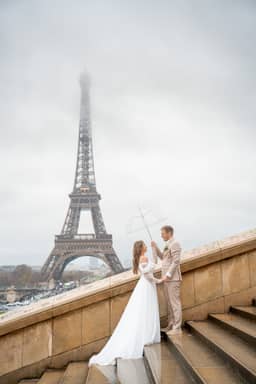
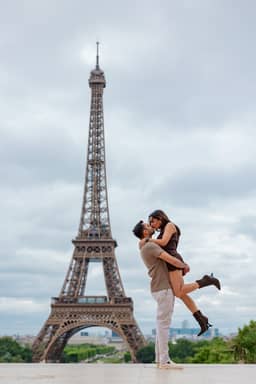
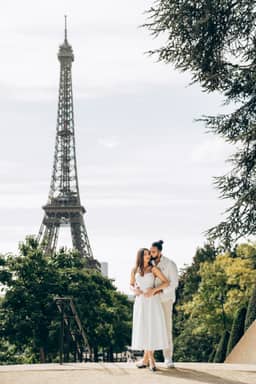
From the Trocadéro esplanade you look south-east across the Seine to the tower, which means the low morning sun rises roughly behind and to the side of it, skimming warm light across the ironwork and lighting the faces of anyone standing with the tower behind them. Early morning is also the only time the esplanade is calm; by mid-morning it belongs to the crowds. For the classic tower portrait in warm light with room to breathe, this is a sunrise location. A guided Eiffel Tower photo shoot from €150 is built around exactly this window.
Pont Alexandre III — sunset
The most ornate bridge in Paris runs along the Invalides to Grand Palais axis, and its gilded statues, Art Nouveau lamps and cherubs are angled to catch the evening sun. At sunset the low western light sets the gold leaf on fire and pours warm colour down the length of the bridge. It is the definitive Paris sunset spot, and a satin gown or a sharp suit photographed here in that last hour looks unforgettable.
Montmartre — late afternoon into evening
Perched on the highest natural hill in the city, Montmartre's western slopes — the vineyard, the little streets below the Sacré-Cœur, the steps looking out over the rooftops — catch the last, longest light of the day as the sun drops toward the west. Late afternoon into early evening is when the village lanes glow and the panorama over Paris turns golden. It is the perfect second location for a session that starts elsewhere at midday and chases the sun uphill as it sets.
Summer Evenings vs Winter's All-Day Glow
The two extremes of the Paris year call for completely different strategies. In summer, the middle of the day is long, bright and harshly lit — not ideal for portraits — but the reward is a spectacular, drawn-out evening. From roughly 8 pm to nearly 10 pm in June, the city bathes in warm light while café terraces fill and the Seine glitters. Summer is made for a late-evening sunset photoshoot, followed straight by blue hour and the tower's first sparkle.
In winter, the sun never climbs high. That sounds like a disadvantage, but for photography it is a gift: the light stays soft, low and golden-ish for much of the short day, so you are not limited to two brief windows. A December shoot at eleven in the morning or two in the afternoon enjoys the same flattering low-angle light that summer only offers at the edges of the day, with far thinner crowds, frost-clear air and no early alarm. Do not write off the cold months; many photographers consider Paris at its most photogenic under low winter sun.
Blue Hour and the City of Lights
When the sun has set and the sky deepens to cobalt, Paris earns its nickname. Monuments light up, bridges glow, and the whole city takes on a cinematic warmth against the blue. This is the moment to photograph the Eiffel Tower at its most spectacular — and there is a specific trick to timing it.
Every night, on the hour, the Eiffel Tower breaks into a five-minute sparkle: thousands of golden lights flicker across the whole structure. It runs from nightfall until late, usually with the last show at 1 am (11 pm in the depths of winter). If you plan a blue-hour shoot to reach a tower viewpoint just before the top of the hour, you can catch the deep blue sky and the sparkle in the same frame — the single most requested Paris night photo there is. Trocadéro, Pont de Bir-Hakeim and the Champ de Mars all put you in position for it.
Why Overcast Days Are Secretly Perfect
Here is the counter-intuitive truth that reassures every traveller checking a grey Paris forecast: overcast is wonderful for portraits. A blanket of cloud turns the entire sky into a giant softbox, wrapping faces in even, gentle light with no harsh shadows, no squinting, and no need to chase a single golden hour. Skin tones render smoothly, colours stay rich and saturated, and you can shoot happily from morning to afternoon rather than racing the sun.
Cloud also does something flattering to Paris itself: it mutes distractions, deepens the greens of the parks and lets the pale stone and the monuments stand out cleanly. A soft, silver Paris sky is not a fallback — plenty of photographers actively prefer it. The only weather that genuinely fights you is hard midday sun in a cloudless sky, which is exactly why golden hour and overcast days are the two reliable friends of a good portrait.
How to Plan a Shoot Around the Light
Putting it all together, planning around light is straightforward once you know the season:
- Check the day's actual times. Use the month-by-month guide above as a starting point, then confirm the exact sunrise and sunset for your date — they shift daily.
- Match the spot to the hour. Trocadéro and the Eiffel Tower for sunrise; Pont Alexandre III and Montmartre for sunset; Haussmann boulevards and courtyards any time the light is low.
- Build in blue hour. If you want the tower sparkling against a cobalt sky, plan the session to end at nightfall and reach a viewpoint just before the hour.
- Keep a weather-proof plan B. If clouds roll in, relax — soft light is a bonus, not a disaster.
- Book the golden window early. Sunrise and sunset slots are the most requested, so reserve them well ahead.
A professional who works in Paris every day already knows which courtyard glows at 7 am in May and where to stand for the sparkle in December — the quiet advantage of booking a local session rather than guessing. A golden-hour Eiffel Tower and Louvre photoshoot from €350 is timed around exactly these windows, at the spots that face the right way at the right hour.
Golden-Hour Packages and Real Prices
You do not need to be a photographer to come home with images that look like golden hour was made for you — you just need to book the right slot. Every Kapturia session shows its real price and a live availability calendar, so you can lock in the sunrise or sunset window that suits your trip in a few minutes, with instant confirmation and nothing to negotiate on arrival.
- Eiffel Tower photo shoot — from €150, timed for the calm, warm light of early morning at Trocadéro.
- Captivating Paris photo tour: Eiffel Tower — from €150, a walking session that follows the light between viewpoints.
- Golden-hour Eiffel Tower & Louvre photoshoot — from €350, a premium session across two icons, timed to the best light of the day.
Browse the full catalog of Paris photoshoots, compare real prices, and reserve the exact golden-hour or sunset slot that fits your itinerary. Pick your date, pick your time, pay securely and get instant confirmation — then all you have to do is show up while Paris turns to gold.
Chase the light, and Paris will do the rest.
FAQ
When is golden hour in Paris?+
Golden hour is the hour just after sunrise and the hour just before sunset, and its clock time shifts across the year. In June the sun rises around 5:50 am and sets near 9:55 pm, so golden light comes very early and very late. In December sunrise is around 8:40 am and sunset around 4:55 pm, so the magic arrives at a far more comfortable hour. Always check the exact times for your date — they move a little every single day.
What is the best time of day for photos in Paris?+
For warm, flattering light the best times are golden hour — the first hour after sunrise and the last before sunset — when the low sun turns Paris limestone honey-gold and softens every shadow. Sunrise has the bonus of near-empty landmarks, which is why Trocadéro and the Eiffel Tower photograph best early. Midday sun is harsh and high, so if you can only shoot then, cloudy weather actually helps by spreading the light evenly.
What is blue hour, and when does the Eiffel Tower sparkle?+
Blue hour is the roughly twenty to thirty minutes after sunset, when the sky turns deep cobalt and the city lights switch on — the most cinematic window for night shots. On top of that, the Eiffel Tower sparkles with thousands of golden lights for five minutes on the hour, every hour after dark, usually until 1 am (11 pm in deep winter). Timing a blue-hour shoot to reach a viewpoint just before the hour captures both at once.
Is sunrise or sunset better for a Paris photoshoot?+
Both give beautiful golden light; the difference is crowds and direction. Sunrise means calm, empty landmarks and cooler air, ideal for Trocadéro and the Eiffel Tower, but you must wake early in summer. Sunset offers warm evening light on west-facing spots like Pont Alexandre III and Montmartre, flows straight into blue hour and the tower sparkle, but the city is busier. In winter both happen at civilised hours.
How much does a golden-hour photoshoot in Paris cost?+
Prices are shown upfront and bookable online instantly. An Eiffel Tower photo shoot timed for morning light starts at €150, and a walking Paris photo tour of the Eiffel Tower also starts at €150. A premium golden-hour session across the Eiffel Tower and the Louvre starts at €350. You pick the sunrise or sunset slot, pay securely and get instant confirmation, with no hidden quote process and nothing to negotiate on arrival.