
Flying Dress Photoshoot in Paris: The Complete Guide to the Iconic Shoot

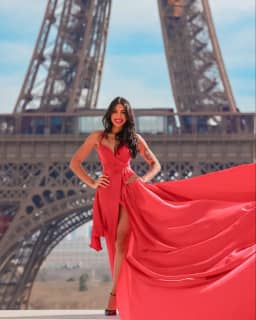
Scroll through any Paris travel feed and it appears within seconds: a woman on the empty Trocadéro esplanade at dawn, the Eiffel Tower rising behind her, and several metres of chiffon suspended in mid-air like a wave of pure colour. That picture is the flying dress photoshoot — currently the most requested photo experience in Paris and one of the most shared travel images in the world. This guide covers everything you need to plan yours: what a flying dress actually is, how the fabric "flies" on command even without wind, which colours flatter which skin tones, the best spots and sunrise times, what to wear underneath, realistic 2026 prices, and how to book the whole experience online in a few clicks.
What Is a Flying Dress Photoshoot?
A flying dress is a gown designed for the camera rather than the wardrobe. Its signature feature is an extravagant train of three to six metres of featherlight chiffon or tulle, cut so that it lifts, floats and billows the moment it is thrown into the air. The bodice is usually adjustable — laced or clipped at the back — so a single dress fits most sizes, and it is worn over your own clothes like a costume. You slip it on at the location in a couple of minutes; no changing room required.
During the shoot, a trained assistant gathers the train, tosses it skyward on the photographer's count, and steps out of the frame. The photographer fires a rapid burst at the precise moment the fabric peaks. The result looks like magic: you appear to stand calmly in a storm of silk while the Eiffel Tower anchors the background. On Kapturia, the complete experience — dress, photographer, assistant and edited images — is available as a flying dress photoshoot in Paris from €360, bookable online with instant confirmation.
Why the Flying Dress Took Over Instagram
The trend was born around 2018 on the caldera cliffs of Santorini, where photographers began renting long-train gowns to travellers who wanted one spectacular image rather than a suitcase of outfits. The formula — one dramatic dress, one iconic backdrop, one perfectly timed throw — proved irresistibly photogenic, and it spread to Dubai, Cappadocia and Paris within a couple of seasons. Today the flying dress hashtags gather hundreds of thousands of posts, and sunrise at Trocadéro has become the Paris version's signature frame.
Paris arguably perfected the concept. Santorini gives you blue domes; Paris gives you the most recognisable monument on Earth, Haussmann stone that glows gold at first light, and bridges that read as pure romance in a single frame. The city also gives the shoot a reason: travellers book flying dress sessions for honeymoons, anniversaries, engagements, birthdays, quinceañeras and solo milestone trips — any moment that deserves more than a phone selfie.
How Does the Dress Actually Fly? The Toss Technique
The number-one question — and the best-kept non-secret of the genre: the dress does not depend on wind. It depends on a technique refined over thousands of shoots, usually called the assistant toss.
- The gather: the assistant collects the full train and folds it loosely over both arms, standing just behind or beside you.
- The count: the photographer frames the shot, locks focus on you and counts down.
- The toss: on "go", the assistant throws the fabric up and outward in an arc and immediately ducks out of frame.
- The burst: for roughly one second the chiffon hangs in the air; the camera fires 8–12 frames per second to catch the perfect peak.
- Repeat: a good session includes dozens of tosses — each one is another chance at the flawless shape.
Your only job is to hold the pose: chin lifted, shoulders relaxed, hands soft, eyes on the lens or drifting toward the Tower. Because the throw does the work, the shoot succeeds even on a perfectly still morning — and a light breeze simply adds bonus movement between tosses.
Best Flying Dress Colours for Your Skin Tone and the Season
Colour is the biggest decision you will make, because the dress fills half the frame. Two rules of thumb: saturated tones photograph better against Paris's cream-coloured stone than pale pastels, and contrast with the sky always wins.
Warm and olive skin tones
Emerald green, royal blue, deep red and burnt orange are spectacular. Mustard and terracotta echo the golden tones of sunrise light and make warm complexions glow.
Fair and cool skin tones
Classic red is the Paris favourite for a reason — it pops against grey skies and blue ones alike. Fuchsia, emerald and sapphire also flatter; very pale pastels can wash out in the soft light of dawn.
Deep skin tones
Bright yellow, cobalt, white and vivid orange create breathtaking contrast and read beautifully from the long camera distances a flying dress requires.
Matching the season
Red and white own the winter months, when skies are moody and the esplanade is empty. Pastel lilac and blush suit spring blossom; yellow and fuchsia sing in summer; emerald and burgundy pair with autumn leaves along the Seine. If you are torn, a red flying dress at Trocadéro is the shot that never misses.
The Best Spots in Paris for a Flying Dress Shoot
Trocadéro at sunrise — the classic
The esplanade of the Palais de Chaillot faces the Eiffel Tower dead-on across the Seine, with nothing between you and the monument but fountains and sky. It is also one of the busiest viewpoints in Europe — which is exactly why flying dress shoots happen at sunrise, when you share it with a handful of joggers instead of thousands of tourists. First light lands around 5:50–6:30 am in June and July, around 7:45 in late September, and closer to 8:40 in December: plan to arrive 15–20 minutes early so you are dressed and posing when the sky turns pink. Metro: Trocadéro (lines 6 and 9), two minutes' walk.
Pont de Bir-Hakeim — industrial romance
A ten-minute walk downstream, this double-deck iron bridge frames the Eiffel Tower between riveted steel columns while metro line 6 rumbles overhead. The repeating arches create natural leading lines, and the raised central walkway keeps you clear of the rare early-morning traffic. Moody, cinematic, and familiar from countless films. Metro: Bir-Hakeim or Passy (line 6).
Pont Alexandre III — gilded drama
The most ornate bridge in Paris: Belle Époque lamps, cherubs and gilded winged horses, with the Grand Palais on one bank and the golden dome of Les Invalides on the other. A red or white flying dress against those gold statues is pure editorial. The Eiffel Tower appears in profile downstream, giving you a second backdrop for free. Metro: Invalides (lines 8 and 13, RER C).
Worth adding if you have time
The Louvre pyramid courtyard (open, geometric, empty before 8 am), the striped columns of Palais-Royal, and the Avenue de Camoëns staircase with its side-on Tower view all take the flying dress beautifully. Many travellers combine two spots in one sunrise session — ask when booking.
What to Wear Under a Flying Dress
The dress goes on over your clothes, so what is underneath matters more than you might think:
- A fitted base layer: a bodysuit, slip dress or fitted top with leggings, in nude or a colour matching the gown — invisible under the bodice, but it may flash during big movements.
- Seamless underwear in a neutral tone; a strapless bra if your dress leaves the shoulders bare.
- Warmth in winter: thin thermal leggings and a long-sleeve base disappear completely under the skirt — Trocadéro at 7 am in January sits around 2–5 °C.
- Shoes: comfortable trainers for walking between spots; slip into heels (or go barefoot on the esplanade) only while posing — the train hides your feet in most frames anyway.
- Hair and accessories: loose hair moves with the fabric and doubles the drama; keep jewellery simple so the dress stays the star.
Weather, Wind and the Paris Sky
Good news: almost every forecast works. A light breeze of 10–20 km/h is the ideal collaborator, holding the fabric aloft a beat longer after each toss. A dead-calm morning is no problem either — the toss technique was invented for exactly that. Only sustained gusts above roughly 35–40 km/h make the train genuinely hard to control, and photographers will usually suggest a more sheltered angle or a short delay rather than cancelling.
Overcast skies are secretly excellent: clouds act as a giant softbox, giving even, flattering light with no harsh shadows — and saturated dress colours look even richer. Light drizzle usually just means shooting between showers; in case of real rain, sessions are typically moved to the next available sunrise, so check the flexibility policy on the service page when you book. Winter mornings bring the emptiest esplanades and the most dramatic skies of the year — red dress, grey clouds, zero crowds.
How the Morning Unfolds: A Realistic Timeline
- When you book: choose your date, time slot and dress colour online; you receive instant confirmation and the exact meeting point.
- The day before: a quick recap confirms sunrise time and the weather outlook.
- 20 minutes before sunrise: meet the team at the spot; the dress goes on over your base layer in about five minutes.
- The golden hour: 45–75 minutes of shooting across two or three micro-locations, with dozens of tosses and pose variations.
- A few days later: your edited high-resolution images arrive in a private online gallery, ready to download and post.
Flying Dress Rental vs Full Photoshoot: Real 2026 Prices
There are two honest ways to get the shot, and Kapturia lists both with transparent pricing:
- Flying dress rental from €150. You rent the gown itself — ideal if you are already travelling with a photographer, or if your partner is handy with a camera and you want the look at the lowest cost. See the flying dress rental in Paris for colours and durations.
- Full flying dress photoshoot from €360. The complete package: the gown, a professional photographer who knows the burst-and-toss timing, an assistant to throw the train, and professionally edited images delivered afterwards. This is the option most travellers choose, because the toss genuinely requires a third pair of hands.
- Prefer volume without the throw? A princess tulle gown with cascading layers rents from €150 and photographs beautifully standing still — a softer alternative for those who want fairy-tale drama without the choreography.
The budget maths is simple: if you need both the dress and someone skilled to shoot it, the full package costs less than assembling the pieces separately — and removes every logistical unknown from a 6 am appointment in a foreign city.
Book Your Flying Dress Photoshoot Online in Minutes
The old way to arrange this was DM-ing photographers on Instagram, negotiating across time zones, and hoping a bank-transfer deposit reached a real person. Kapturia replaces all of that with instant online booking: transparent prices, real availability calendars, secure card payment and immediate confirmation — in your language and your currency. Browse the full catalogue of Paris photoshoots, pick your sunrise, choose your colour, and the hardest thing left is deciding which final image to frame.
Pro tip: book the earliest slot available for your date. The first 30 minutes after sunrise deliver the softest light, the emptiest Trocadéro and the calmest air of the entire day — the flying dress trifecta.
One dawn, one dress, one perfectly timed throw — and a photograph you will never have to explain. That is the flying dress promise, and Paris keeps it better than anywhere else in the world.
FAQ
How much does a flying dress photoshoot cost in Paris?+
On Kapturia, the full experience — flying dress, professional photographer, assistant for the toss and edited images — starts at €360. If you already have a photographer, you can rent the flying dress alone from €150, and a cascading princess tulle gown is also available from €150. Prices are shown transparently on each service page, and you pay securely online with instant confirmation.
Does the dress really fly, or is it the wind?+
It is technique, not weather. An assistant gathers the multi-metre train, tosses it into the air on the photographer's count, and steps out of frame while the camera fires a rapid burst. The fabric hangs for about a second — long enough to capture a perfect arc. That is why flying dress photos work even on completely windless mornings, and why a session includes dozens of tosses.
What should I wear under a flying dress?+
The gown is worn over your own clothes. Choose a fitted, neutral base: a nude or colour-matched bodysuit or slip, seamless underwear, and in winter thin thermal leggings that vanish under the skirt. Bring comfortable shoes for walking between locations — your feet are hidden by the train in most shots, so heels are optional and barefoot posing is common on the esplanade.
Where and when is the best flying dress shoot in Paris?+
Trocadéro at sunrise is the undisputed classic: a straight-on Eiffel Tower view and almost no crowds at first light, which arrives around 6 am in summer and closer to 8:40 in winter. Pont de Bir-Hakeim adds industrial romance, and Pont Alexandre III adds gilded Belle Époque drama. Many sessions combine two spots within one golden hour, so ask when you book.
Can I book a flying dress photoshoot online instantly?+
Yes. On Kapturia you choose the service, date and time slot, pay securely by card and receive immediate confirmation with the exact meeting point — no Instagram DMs, bank-transfer deposits or language barriers. Booking a few days ahead is enough in most seasons, but summer sunrise slots at Trocadéro are the first to sell out, so reserve those as early as you can.