Notre-Dame Photoshoot: The Île de la Cité Guide

The spots on the map
All 45 real photo locations — tap a pin to see the spot and book it.
On 7 December 2024, after more than five years of scaffolding, silence and painstaking craft, Notre-Dame de Paris reopened its doors. The fire of April 2019 had taken the spire and the medieval oak roof; the restoration gave back the pale, luminous stone, the rebuilt flèche and a cathedral that looks, improbably, cleaner than it has in a hundred years. For anyone planning a Notre-Dame photoshoot in 2026, the timing has never been better: the most famous Gothic façade in the world is scrubbed bright and glowing, and the island it stands on — the Île de la Cité — is once again the beating heart of a photographer's Paris.
This guide is about that half-mile of history. Not only the cathedral, but the whole island around it: the garden behind the apse, the oldest bridge in the city, the willow-shaded tip where the Seine splits in two, a hidden triangular square, a Belle Époque flower market and the green booksellers' boxes lining the quays. Below you will find the best angles, the honest truth about crowds and light, how to fold an Île de la Cité photoshoot into a Louvre or Marais morning, and real, instantly bookable prices — with nothing hidden behind a quote form.
Why the Île de la Cité Is the Historic Heart of Paris
Paris was born here. Two thousand years ago the Celtic Parisii built their settlement on this boat-shaped island in the Seine, and the Romans made it the centre of Lutetia. Everything the city became radiated outward from these few hectares. The Île de la Cité still carries an astonishing density of monuments — Notre-Dame, the jewel-box Sainte-Chapelle, the Conciergerie where Marie-Antoinette was held, the long façades of the Palais de Justice with their gilded railings — but for photography its real gift is variety. In a fifteen-minute walk you move from monumental Gothic grandeur to intimate, almost village-like corners, all framed by water and changing light.
That contrast is what makes the island such a rewarding shoot. You can open with the drama of the cathedral, soften into the quiet of Place Dauphine, then finish at the water's edge under a weeping willow with the river sliding past. One place, many moods — and because everything is walkable, a single morning is enough to build a full, varied gallery.
One point of orientation worth knowing: the small bronze star set into the pavement in front of the cathedral is Point Zéro des Routes de France, the exact spot from which every road distance in the country is measured. Stand on it and you are, quite literally, at the centre of France.
The Best Angles of Notre-Dame
The cathedral is not one photograph; it is at least three, each with its own best hour and its own best light.
The West Façade and the Parvis
The twin towers, the great rose window and the three carved portals make up the view everyone pictures. It is shot from the parvis, the open square in front, and it is spectacular — but it faces west, which matters for timing: the façade catches warm, direct light in the late afternoon and at sunset, not first thing in the morning. It is also, since the reopening, the busiest spot on the whole island. Come at first light if you want the stone to yourself, or embrace the late golden hour, when the setting sun turns the entire front to amber.
The Apse and Flying Buttresses from Square Jean-XXIII
Walk around to the back and the cathedral changes character completely. Behind the choir, Square Jean-XXIII is a calm formal garden that delivers the most graphic view of Notre-Dame: the soaring apse and the great splayed arcs-boutants — the flying buttresses — radiating outward like ribs. Crucially, this east end faces the morning sun, so at sunrise the stone here glows while the façade is still in shadow. It is quieter than the parvis, greener, and the ornamental fountain and rows of trees hand you foreground and framing that the front simply cannot. For many photographers this is the single best angle of the entire building.
The Postcard View from the Left Bank
For the classic wide shot — the whole cathedral rising above the river — cross to the Left Bank. From Quai de Montebello and the little Square René-Viviani you get Notre-Dame mirrored in the Seine with a bridge in the foreground. Square René-Viviani hides its own secret: a false acacia planted around 1601, said to be the oldest tree in Paris. A few steps away stands the famous Shakespeare and Company bookshop, a charming English-language literary corner that makes an easy add-on backdrop. And between the bank and the island, the Pont de l'Archevêché offers what many consider the finest side view of the cathedral's east end — once famous for the love-locks removed in 2015, it is now simply a superb, uncluttered vantage point, best in soft early light.
The Tip of the Island: Pont Neuf and the Square du Vert-Galant
Pont Neuf, the Oldest Bridge in Paris
Its name means "New Bridge," which is the city's oldest joke: completed in 1607 under Henri IV, the Pont Neuf is in fact the oldest bridge still standing in Paris. It was revolutionary in its day — the first Paris bridge built without houses crowding its span, and the first with raised pavements for pedestrians. Look for the rows of stone mascarons, the grotesque carved faces along its sides, and the equestrian statue of Henri IV where the bridge crosses the island. It photographs beautifully in both directions and links the Cité to the Louvre in a two-minute walk.
Square du Vert-Galant at Water Level
Slip down the steps behind the statue and you reach the Square du Vert-Galant, a small triangular garden at the very downstream tip of the island, right at the level of the Seine. "Vert-Galant" — the "Green Gallant" — was Henri IV's affectionate nickname. This is one of the most romantic corners in Paris: weeping willows trailing into the water, the river forking around you, and long views downstream toward the Louvre and the Pont des Arts. Down here you sit below the traffic and the crowds, and the light bounces up off the water — a photographer's dream at sunrise or in the blue hour after sunset.
Place Dauphine: The Quiet Heart of the Island
Just east of the Pont Neuf, tucked behind a modest gap in the buildings, lies Place Dauphine — a serene triangular square laid out by Henri IV in 1607 and named for the Dauphin, the future Louis XIII. Ringed by old façades, chestnut trees and a handful of quiet restaurant terraces, it feels like a village square dropped into the middle of the capital. The traffic noise vanishes. It is the perfect counterpoint to the grandeur of Notre-Dame: soft, human-scaled and almost always calm, ideal for relaxed portraits under dappled light.
The Flower Market and the Bouquinistes
Two more living, colourful details complete the island. In the middle of the Cité, on Place Louis-Lépine, the Marché aux Fleurs Reine Elizabeth II — renamed after the Queen's 2014 visit — fills a set of elegant Belle Époque metal pavilions with plants and cut flowers every day of the week. Its green ironwork and banks of blooms make a joyful, saturated backdrop that is quintessentially Parisian.
Along the stone parapets of the quays run the bouquinistes, the open-air booksellers whose weathered green boxes have sold second-hand books, prints and vintage posters for generations. They are so woven into the city that the banks of the Seine — bouquinistes included — are a UNESCO World Heritage Site, and when there was talk of moving them for the 2024 Olympics the plan was dropped after a public outcry. Their green boxes half-open over the water, with Notre-Dame in the distance, are one of the most authentically Parisian frames you can find.
Morning Light and Beating the Crowds
Since the reopening, the Île de la Cité is busier than ever, so timing is everything. The single best piece of advice is simple: start early. Arrive at sunrise and for the first hour you will practically have the parvis, the gardens and the bridges to yourself, with soft golden light on clean stone. By mid-morning the tour groups arrive and the spell thins out.
Remember the compass, too. The apse and Square Jean-XXIII face east and glow at sunrise; the west façade faces the setting sun and is best in the late afternoon and at golden hour. Blue hour — the twenty minutes after sunset — is pure cinema down at the Square du Vert-Galant and along the quays, when the sky turns cobalt and the bridge lamps flicker on. And do not fear a grey Paris sky: an overcast day is a giant softbox, wrapping the stone in even, flattering light with no harsh shadows.
What to Wear and Practical Tips
A few practical notes make the day run smoother. The quays and the bridges over the Seine can be breezy, so a dress with movement will photograph beautifully — but pin down anything that has to stay in place. Wear comfortable shoes for the cobblestones between locations and carry heels for the frames that need them. There is no ticket and no queue for an outdoor session, but if you want to include the interior of Notre-Dame or the stained glass of the Sainte-Chapelle, reserve those timed-entry slots separately in advance. Finally, bring a light layer: Paris mornings are cool even in summer, and the best light arrives before the cafés have opened.
Combining the Island with the Louvre or the Marais
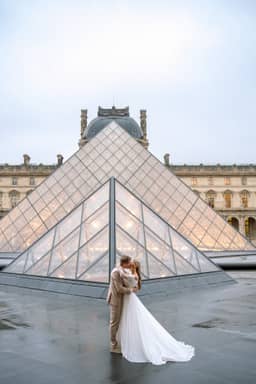
The Île de la Cité sits exactly between two of the best photo neighbourhoods in Paris, and the walk to either is short. Cross the Pont Neuf and you are minutes from the Louvre, where the glass pyramid and the palace courtyards make a natural second act — a bespoke Louvre photography experience starts at €150 and pairs seamlessly with a Notre-Dame morning. Step across a bridge on the other side and you are in the Marais, with its medieval lanes and the arcades of the Place des Vosges.
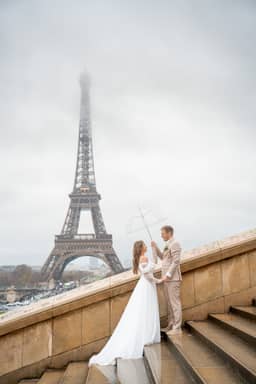
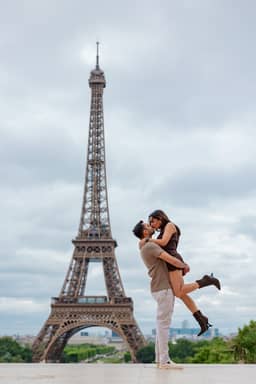
If your dream frame is the Eiffel Tower as well, that is an easy extension: a captivating Eiffel Tower photo tour also starts at €150 and can be built into a longer route across the city. The beauty of the island is that it anchors a walking shoot perfectly — history at the centre, icons a short stroll in every direction.
Real Packages and Real Prices
Here is what a professional session around the historic heart actually costs — real prices, shown openly and bookable online today:
- Bespoke photography experience — from €150, a tailored session your photographer can route through the Île de la Cité and the Louvre.
- Captivating Paris photo tour — from €150, a walking shoot built around the city's icons.
- Eiffel Tower & Louvre photoshoot — from €350, a premium two-icon experience for travellers who want the whole postcard.
Every figure is the real starting price, listed upfront. There is no hidden quote process and no waiting days for an email in French: you see the rate, you pick your slot, you book.
Booking Your Notre-Dame Photoshoot
Kapturia was built to make this the easy part. Every service shows its real price and a live availability calendar: choose your date, choose your time, pay securely online, and your confirmation arrives instantly — often before you have even booked your flights. Browse the full catalogue of Paris photoshoots, compare real prices side by side, and lock in the morning that fits your trip in about three minutes.
Paris began on this island. Let your Paris photographs begin here too.
FAQ
Can you photograph Notre-Dame now that it has reopened?+
Yes. Notre-Dame reopened on 7 December 2024 after its five-year restoration, and the exterior looks better than it has in a century. Outdoor photography around the cathedral and across the Île de la Cité is completely free and needs no permit. The interior reopened too, but it uses free timed-entry reservations, so book those separately if you want to shoot inside.
Do you need a permit for a photoshoot on the Île de la Cité?+
No. A personal photoshoot with a handheld camera in public space — the parvis, the gardens, the bridges, the quays and the Square du Vert-Galant — is free and needs no authorisation. Permits only apply to large commercial productions with crews, heavy lighting or blocked-off areas. Drones are banned over central Paris, and museum interiors have their own separate rules.
What is the best time of day for a Notre-Dame photoshoot?+
Early morning, without question. Arrive at sunrise and you will have the parvis, the gardens and the bridges almost to yourself, with soft light on clean stone. The apse and Square Jean-XXIII face east and glow at dawn; the west façade faces the setting sun and is best in the late afternoon. Blue hour after sunset is pure magic down at the water's edge.
What are the best photo spots on the Île de la Cité?+
Start with Notre-Dame — the west façade from the parvis and the flying buttresses seen from Square Jean-XXIII. Then walk to the Pont Neuf, the oldest bridge in Paris, and down to the Square du Vert-Galant at the water's edge. Add the peaceful Place Dauphine, the Belle Époque flower market and the bouquinistes' green boxes lining the quays.
How much does a Paris photoshoot around Notre-Dame cost?+
A professional session starts at €150, and your photographer can route it through the Île de la Cité, past Notre-Dame and the Pont Neuf, and on to the nearby Louvre. A premium two-icon experience covering the Eiffel Tower and the Louvre is €350. Every price is shown upfront with a live availability calendar, so you can book online in about three minutes.